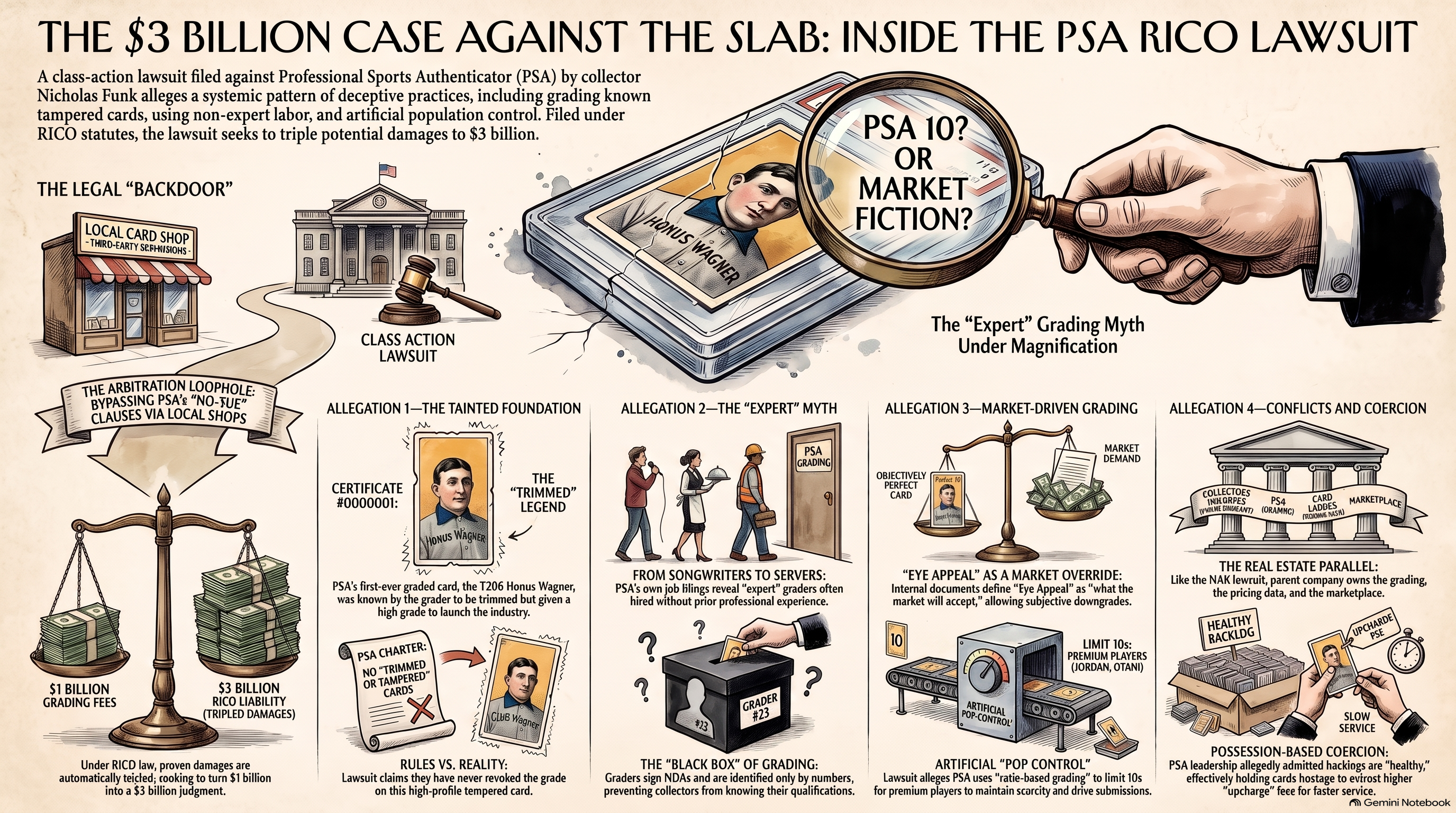
A collector in Baltimore sent about seven Cal Ripken Jr. rookie cards through his local card shop in March 2025. He paid roughly $300 in grading fees. That submission is now the basis of a federal class-action lawsuit against PSA and its parent company, Collectors Holdings, filed under the federal racketeering statute.
The case is real. Funk v. Collectors Universe, Inc. et al., Case No. 1:26-cv-02933-JKB, filed July 28, 2026, in the U.S. District Court for the District of Maryland. Plaintiff Nicholas Funk. The complaint runs 188 pages and brings claims under RICO (alleging mail and wire fraud), the Maryland Consumer Protection Act, and several common-law theories. It estimates PSA collected roughly $1 billion in grading fees during the proposed four-year class period, a figure that, if RICO's automatic trebling applied, could theoretically reach around $3 billion. That number is the plaintiff's opening ceiling. It is not a verdict, not a settlement, not even a certified damages model. No court has ruled on any of it yet.
If you have seen this story already, you probably saw it somewhere breathless. A lot of the coverage that spread this week leaned on overheated framing and analogies that did not hold up.
I appreciate the covering of the lawsuit but bro gotta work on his analogy scenariosView the original post
Wow. He found what's given to the public.View the original post
Both comments are aimed at the video that kicked off this round of coverage, and both land. So this piece sticks to the filing itself: what it alleges, what is already public record, and what is still just an argument one side is making in a document a court has not ruled on.
The arbitration theory
The legal hook that makes this case different from past suits against PSA is procedural, not sensational. Funk did not submit his cards directly to PSA. He went through a local card shop that handled the submission on his behalf. Because of that, his complaint argues, he never personally opened a PSA account, never clicked through PSA's Terms of Service, and never agreed to the arbitration clause and class-action waiver buried in it. If he never agreed to arbitrate, he argues, he is not bound by it, and neither is anyone else who graded through an intermediary rather than a direct account. The proposed class is defined specifically around that population: customers who came in through a shop, a break, or another middleman. The complaint frames that as a large group PSA's arbitration clause was never actually able to reach.
It is a clean theory on paper. Whether it survives contact with a judge is a separate question, and collectors who have actually read PSA's submission paperwork are skeptical.
If you're sending through your lcs and didn't sign anything, isn't the issue then between you and the lcs?View the original post
That is the practical counterargument: even if Funk never personally signed PSA's terms, the shop that submitted on his behalf may have, and any dispute over that relationship could sit between him and the shop rather than him and PSA. Nobody has ruled on that either. It is one of several places where this case will actually be decided on contract law, not on how bad PSA looks in a 188-page filing.
Certificate #0000001
Buried in the complaint is a section revisiting the single most argued-about card in the hobby: PSA's first-ever certified card, a T206 Honus Wagner, graded NM-MT 8 in 1991. It later sold for $2.8 million. This is not a new controversy. It has followed the card for over three decades. But two separate facts get flattened into one in a lot of the recent coverage, and they need to stay separate.
First: the 2026 complaint alleges PSA knew, or should have known, that the Wagner card had been trimmed when it was originally graded in 1991. That is an allegation in an active, unproven lawsuit. It is not a finding, an admission, or a ruling.
Second, and unrelated to this lawsuit: in 2013, Bill Mastro, the auction house dealer who sold the card, pleaded guilty to mail fraud in a criminal case over shill bidding at his auction house. As part of that plea, Mastro admitted he personally trimmed the Wagner card himself in the 1980s, before it was ever submitted for grading. Mastro was never a PSA employee. PSA's founder, David Hall, has consistently disputed that the card was trimmed and has not revoked its grade.
So: the lawsuit alleges PSA should have caught something. A different person, in a different case over a decade ago, admitted to doing the trimming. Nobody at PSA has admitted anything in any courtroom. Keep those two facts apart when you see this story summarized elsewhere, because a lot of the coverage this week did not.
"What will the market accept"
The complaint's more interesting argument is about what grading actually measures. PSA markets its grading as an objective, standardized process. The complaint quotes PSA's own published grading standards, at psacard.com/gradingstandards, which describe part of the process through the question: "What will the market accept for this particular issue?" That is PSA's own language, not something the lawsuit invented. The complaint argues that a market-sensitivity test built into the standard undercuts the marketing claim that grading is purely objective.
Attached to that, the complaint alleges PSA uses what it calls "ratio-based" grading, meaning it applies heightened scrutiny to premium modern cards specifically to manage how many Gem Mint 10s exist for a given release, which in turn affects scarcity and price. The complaint does not name specific players in connection with this claim in any way that could be independently confirmed, so neither will this piece.
The complaint also alleges PSA's grading workforce includes trainees and contractors, some with little to no prior grading experience, that PSA does not require formal outside certification for graders, and that customers are never told who graded their card or what that person's qualifications are. That last point is one collectors have been raising informally for years, lawsuit or not.
whether this suit is successful or not, imo there will come a day when psa loses the respect they once had, and millions of psa cards will be questioned by most buyers and lose value because of the psa name. I just call bullshit on their consistency, every grader grades different, how do they grade during their 1st hour as opposed to their 8th hour of staring at cards all day, and with 1000s of graders, I just dont see a point, it just depends what grader.View the original post
That skepticism is not new and does not depend on this lawsuit succeeding to be a fair critique. It is worth separating from the RICO claim itself: even collectors who think the legal theory goes nowhere still raise the same underlying question about grader consistency.
The complaint's other big structural argument is about who else Collectors Holdings owns. Beyond PSA, the parent company also owns Card Ladder, the price-tracking data service collectors use to check comps; card storage and vaulting; a resale and "instant cash offer" arm; and lending and financing products tied to graded cards. The complaint argues this vertical integration gives Collectors Holdings a direct financial stake in the value and scarcity of the exact cards PSA itself grades, which it says contradicts PSA's marketing claim of having no financial stake in grading outcomes.
That is the kind of allegation that does not need a courtroom to make collectors think about a competitor. PSA is not the only grading company out there.
Seems like Tag should start offering a discount to crack your PSA slabs and regrade. Opportunity to disrupt and provide data to back it up.View the original post
Except TAG system is complete shit lol.View the original post
Even inside a thread about PSA's problems, nobody is treating the alternatives as an easy fix. That is the more honest version of where the community actually sits.
The backlog behind the timing
Part of why this lawsuit is landing now is volume. PSA's total submission backlog reportedly reached about 11 million cards by July 14, 2026, and about 12.4 million by July 28, the day the suit was filed. PSA graded roughly 2.5 million cards in June 2026 alone, a 74% year-over-year increase, and independent reporting has put PSA's throughput at roughly 90,000 cards per day globally in early 2026. Those numbers describe a company scaling grading volume fast, not one standing still. Whatever a court eventually decides about the legal claims, the operational strain behind them is real and documented.
Not the only case, not the first RICO theory
Two other pending lawsuits against Collectors Holdings entities are easy to lump in with Funk's case. They are not the same case, and they should not be treated as one.
Rasmussen v. Collectors Holdings is an antitrust suit over Collectors Holdings' acquisitions of SGC and Beckett, filed in April 2026 and amended in August 2026. Collectors Holdings has already moved to dismiss and to compel arbitration in that case. A company spokesperson described those claims as "long on rhetoric but devoid of substance." That is a reasonable signal for how Collectors Holdings might respond to Funk's complaint too, though that is not confirmed.
Lichtman v. Collectors Universe alleges that CEO Nat Turner's personal card collection created a conflict of interest in grading decisions. Also separate. Also not part of Funk's claims.
There is also a more direct precedent worth knowing: a 2020 RICO lawsuit against the same corporate family, Savoy v. Collectors Universe, was ultimately dismissed. That is the realistic bar Funk's RICO theory has to clear, and it did not clear it the last time someone tried.
For scale, the comparison getting thrown around this week is real estate's Sitzer/Burnett case: in October 2023, a federal jury in Missouri found the National Association of Realtors and co-defendant brokerages liable on antitrust claims and set damages at $1.78 billion. But the actual settlements that followed, across NAR (about $418 million) and the major brokerage defendants (HomeServices of America around $250 million, Keller Williams around $70 million, Compass around $57.5 million, RE/MAX around $55 million, Anywhere around $83.5 million, plus a number of smaller regional brokerage settlements), added up to roughly $1.04 to $1.05 billion, not the higher figure sometimes quoted. The 8th Circuit Court of Appeals affirmed more than $1 billion of those settlements on August 19, 2026, one day before this piece went up. If there is a lesson in that case for this one, it is that a headline damages number and an eventual settlement number are usually two very different figures, separated by years.
What actually happens next
As of this writing, PSA and Collectors Holdings have not filed a formal response to the complaint. No class has been certified. No court has ruled on any substantive claim. A class-action intake site, psacardclassaction.com, run by the law firm representing Funk (Zealous Advocates, with attorneys Jeremy Eldridge and Thomas R. Bundy III of Eldridge Crandell LLC named in coverage as counsel), correctly states that plainly: no class has been certified yet.
The most grounded prediction in the whole comment thread on this story came from someone not trying to be dramatic about it either way.
As much as I like the idea of a PSA takedown, I'm sure it will result in a settlement, no admission of guilt, and then back to business as usual.View the original post
Given the 2020 dismissal of a similar RICO theory against this same company, and Collectors Holdings' "long on rhetoric" posture toward the Rasmussen suit, that is not a bad bet. This is a real complaint with real, specific allegations, an arbitration theory that has not been tested, and a headline number that is not the number anyone should expect to see at the end. What is actually worth watching is not the $3 billion figure. It is whether the arbitration-loophole theory holds up, since that is the part of this case that could reach every collector who has ever sent cards through a shop instead of a direct PSA account, win or lose.
Not financial advice. Nothing here changes what your graded cards are worth today. It might change what "PSA graded" means to a buyer down the road, and that is worth watching regardless of how this specific case ends.